Tanzania’s National parks and highlights

Welcome to the heart of Tanzania's wilderness, where Summa African Adventure invites you to explore the breathtaking Serengeti and Ngorongoro National Parks. Prepare to be amazed by the unparalleled beauty and rich wildlife that awaits.

The Serengeti National Park

Serengeti National Park, endless savannahs, dramatic sunsets, and some of the richest wildlife on the planet — safari heaven. Home to one of the world's largest concentration of wildlife and the majority of the Great Wildebeest and zebra Migration, is Tanzania's flagship and a must-visit for both first-time and returning safari visitors.

The name of the Serengeti National Park is derived from the Maasai people and literally means 'endless plains.' With an area of over 14,763 square kilometers, the park is the third largest national park in Tanzania.

In total, more than 3.5 million animals live in Serengeti National Park!
These include the big five elephants, lions, buffaloes,leopard and Rhinoceros, hippos, waterbucks, pigs, and various species of antelopes and primates, more than three thousand lions, around 225 cheetahs, about a thousand leopards, around 3,500 hyenas, and several hundred wild dogs.
Thanks to the beautiful and unique nature in this area, the park has been designated as part of the UNESCO World Heritage List. This means that the park is protected, allowing nature and the animals here to thrive in peace.

Summa African Adventure offers unforgettable safari experiences tailored to your interests and preferences.

Book your safari trip here.

UNESCO World Heritage List
endless plains.'
 the richest wildlife on the planet

The Ngorongoro Conservation Area

The Ngorongoro is a volcano comparable in size to Kilimanjaro (5895m). Both mountain peaks proudly tower over the vast, wildlife-rich savanna plains. This was the reality until the Ngorongoro volcano erupted around 2.5 million years ago, transforming into a gigantic caldera. Today, it is even the largest intact caldera in the world! The breathtakingly beautiful Ngorongoro Crater stands out in almost every safari through northern Tanzania due to its high concentrations of wildlife. The Ngorongoro Crater has the highest wildlife density per square meter in Africa.Finally, the fertile and mineral-rich soil on the crater floor is highly favored by the local Maasai, who graze their livestock there. During a jeep safari in the crater, you not only enjoy the highest density of wildlife in Africa, but you also capture stunning photos of passing Maasai people on their way with their goats and cows.

Experience for yourself with all your senses why the crater has been designated a UNESCO World Heritage site!


 Ngorongoro volcano
photogenic baobab, Tarangire River

Tarangire

Scenically, Tarangire is the most beautiful wildlife park in northern Tanzania. The enormous national park has as its lifeline the wildlife-rich Tarangire River. The park is dominated by photogenic baobab and palm trees scattered throughout the hilly landscape. These trees can live for hundreds of years, and elephants use a special technique to extract moisture from them. In addition, the Tarangire River that runs through the park is the only other water source during this season. So you can imagine that this place is a paradise for large herds of up to 250 elephants. It provides unique opportunities to observe the interactions between elephant families. We will do a game drive through the park, depending on reported sightings of animals (mostly predators like lions, cheetahs, and leopards, as they are harder to spot). The herbivores, such as giraffes, wildebeests, zebras, etc., are plentiful and easy to spot in the park.

Camping at the nature campsite of this beautiful national park is an experience in itself. Fall asleep to the honking of elephants and the howling of hyenas in the background. In my opinion, this experience is definitely one of the Tanzania highlights!


Enjoy on the bounty island of Zanzibar

is both a historic and idyllic island. With its bloody slavery past, spice plantations, tropical beaches, and palm forests, this archipelago impresses its visitors. Relax on the beach of Nungwi, eat at the street market of Forodhani Gardens, and visit the slave fort in Stone Town. You can swim with dolphins in Kazimkazi, snorkel at Mnemba Island, and surf at Paje.

 beach of Nungwi
tree-climbing lions,  Elephant Paradise

Lake Manyara:

The Elephant Paradise Lake Manyara is a lush and water-rich wildlife park in Northern Tanzania. The forested area is home to a large elephant population and houses rare tree-climbing lions. This special lion species is only also found in the Ishasha sector of Uganda's Queen Elizabeth National Park. After a beautiful safari, you can enjoy dance performances in the nearby Mto wa Mbu, play football on dusty fields, or buy textiles (kitenge) at the local market.


Kilimanjaro:

The Icon of Tanzania Kilimanjaro, besides a safari, is for many an important reason to visit Tanzania. Passionate climbers and motivated hikers attempt to scale Africa's highest free-standing mountain during a multi-day trek. Under the guidance of a guide and porters, they try to tame the Tanzanian giant in a battle against themselves. Even if you are not interested in climbing 'the Kili,' you can enjoy stunning views of this Tanzanian giant from Moshi or the Serengeti National Park. But as one of the main attractions in Tanzania, it is actually a must to include Kilimanjaro in your travel itinerary during your Tanzania vacation.



 Icon of Tanzania Kilimanjaro

                  Big Migration

Tanzania is home to one of the largest animal migrations on the planet: the Great Wildebeest Migration. Summa African Adventure ensures that you witness it.

Natural phenomena occur all over the world, but few can compete with the immense scale of the annual wildebeest migration through the Serengeti-Mara ecosystem. The sheer numbers alone are difficult to comprehend: up to 2 million animals – wildebeests, but also zebras and gazelles – follow the rain and their ancient instincts on a life-threatening journey of 3,000 kilometers (1,900 miles). It is drama on a truly epic scale: the migrating herds face all kinds of challenges and hardships as they move from one area to another. They are constantly attacked by predators, none as ferociously as by Africa's big cats – lions, leopards, and cheetahs – and the enormous crocodiles that await them at various river crossings.

annual wildebeest migration
the Kuringe waterfalls

Materuni Waterfall, Chemka Hot Springs, and a coffee tour

A walk from Materuni to the Kuringe waterfalls is perfect for those who want to experience Mount Kilimanjaro without actually climbing it! From Materuni, a local guide takes you on a beautiful 40-minute walk to the amazing 70-meter-high waterfall. At 2,500 meters above sea level, the trail passes through valleys and tropical rainforests, with stunning wide views and plantations full of coffee, bananas, and avocados.

A highlight is the coffee plantation where you can participate in the coffee-making process. Taste the delicious coffee and the delightful lunch prepared for you by the team.

The Chemka Hot Springs are an oasis in the hinterland of Kilimanjaro, located 40 kilometers from Moshi. At these idyllic underground springs with crystal-clear, turquoise water, you can enjoy perfect tranquility. The pond is very deep, in some places up to 10 meters, but the water is so clear that you can always see the bottom clearly.

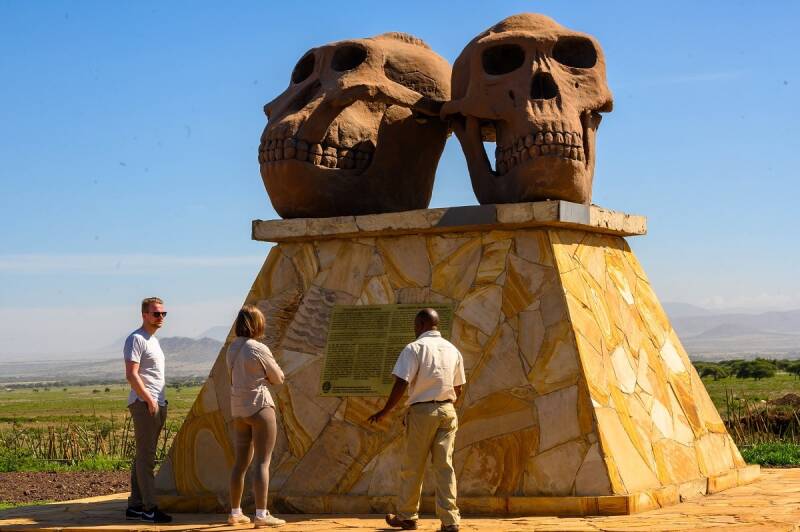
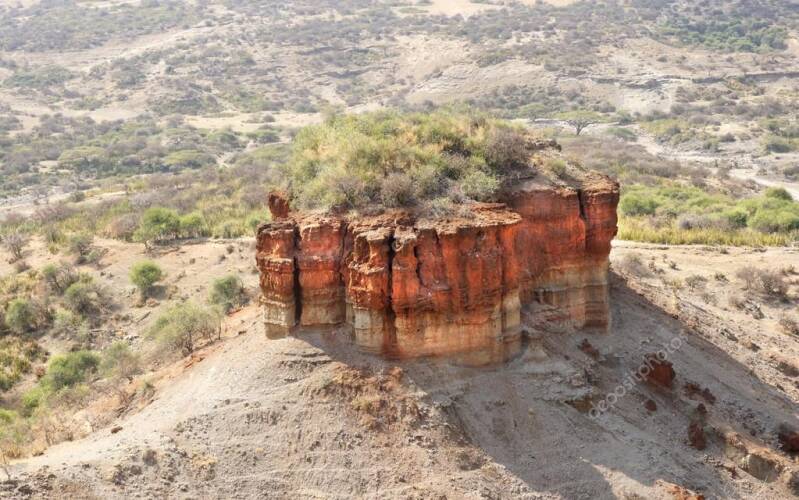
Olduvai Gorge
pre-human ancestors


Olduvai Gorge

Olduvai Gorge contains the earliest remains of our human and pre-human ancestors. Paleoanthropologists have discovered hundreds of fossilized bones and stone tools dating back over 2 million years.
The gorge was made most famous by the work of the "First Family of Paleontology," Louis and Mary Leaky. It all began in 1959 when Mary discovered parts of a skull and upper jaw of a previously unidentified hominid. Over a week, the Leaky family uncovered 400 pieces of a nearly complete skull, similar to other discoveries by Raymond Dart and Robert Broom in South Africa. The Leaky family classified their find as a new category of Australopithecus and named it Zinjanthropus Boisei, which experts later renamed Paranthropus Boisei. At 1.75 million years old, it was the oldest known hominid. The work of the Leaky, Dart, and Broom families finally brought Africa to the world's attention as the place where humanity originated.
The Olduvai Gorge site is protected by the Tanzania National Parks Authority. The Olduvai Gorge Museum is managed by the Tanzanian Department of Cultural Antiquities. Ngorongoro, including Olduvai, has been designated a United Nations Educational, Scientific, and Cultural Organization (UNESCO) World Heritage Site.

Arusha national park

Arusha National Park is evergreen and boasts a wide variety of landscapes: steppes, jungle, and high mountains. Two ancient volcanoes dominate the park: Mount Meru, which rises to 4,566 meters, and Ngurdoto, which has a diameter of 3.6 kilometers and a depth of 100 meters. A swamp on the crater floor is home to a wealth of wildlife.

Arusha National Park isn't known for its large (predatory) animals, but it is home to many smaller species of animals and birds. Despite its size, the park's flora and fauna are incredibly diverse. You can encounter wildlife such as giraffes, zebras, large herds of buffalo, leopards, and spotted hyenas. The park is also the only place in northern Tanzania where the black-and-white colobus monkey lives. The Momela Lakes lie in the northeastern section of the park. These are a magnet for sometimes thousands of flamingos. Many other aquatic bird species can also be found here. The number of different bird species is estimated at 400. Bird lovers come here especially for the turacos and trogons.

Arusha National Park

Serval Wildlife sanctuary

Step into the peaceful wilderness of Serval Wildlife Sanctuary
Discover the wonders of Serval Wildlife Sanctuary with a guided day tour. Meet lions, giraffes, and other incredible animals while gaining insights from professionals.
The sanctuary provides a natural environment for rescued and protected animals. Lions are the only species kept in enclosed spaces for their safety.
This day trip to the sanctuary offers a chance to connect with nature in a meaningful way. Take a guided walk, observe animals in their natural habitat, and learn more about conservation efforts in Tanzania.
Take beautiful photos, enjoy the tranquil atmosphere, and enjoy a picnic-style lunch. Ideal for nature lovers, photographers, and adventurers, this trip offers a refreshing escape into the wild beauty of Tanzania.
You will have a day you will never forget.

Serval Wildlife Sanctuary with a guided
Ndutu Area

Ndutu Area

The Ndutu Area, which forms the southern part of the Serengeti, is part of the Ngorongo Conservation Area.
The Ndutu Area is known for its short-grass plains, where particularly nutritious grass grows that the migrating animals feed on during the birth of their young. Traditionally, wildebeest and zebras shed their chalk feathers on these plains, peaking around February. This creates a beautiful natural spectacle and exciting hunts by predators. The wildebeest continue to graze on the short-grass plains well into March and April, strengthening themselves for the long migration north, which follows the rainfall and the new pastures.

This is also the place where the Great Migration begins every year, as the wildebeest and zebras trek north with their calves, through Serengeti National Park, in search of fresh food and water. However, many wild animals also stay behind. As a result, you can spot wildlife there all year round.

    Mkomazi National Park

Mkomazi National Park is a spectacular wilderness. Kilimanjaro, Africa's highest peak, lies in view to the northwest. To the south, the Pare and Usambara mountains form an impressive backdrop, and to the north, Kenya's vast Tsavo National Park borders Mkomazi, making it a common territory for migrating herds of elephants, oryxes, and zebras during the rainy season. Together with Tsavo, it forms one of the largest and most important protected ecosystems in the world.

Mkomazi National Park was established as a wildlife reserve in 1951 and was upgraded to national park status in 2006. There is somewhat less variety of wildlife than in most other national parks in Tanzania, but this is more than compensated for by the beautiful landscape. It is therefore an ideal park and certainly worth a visit if you enjoy remote areas with beautiful, wild, mountainous scenery where you can also spot wildlife.

spectacular wilderness
tropical rainforest

Usambara Mountains

The Usambara Mountains are an international hotspot for biodiversity and a colorful introduction to a gem of Tanzania. It is a paradise for hikers and offers a variety of activities. The highest point of the mountain range, Chambolo Peak, lies at 2,289 meters above sea level. The mountains are separated by a valley and can be divided into a western and eastern part. The first habitation of the area dates back approximately 1.5 million years, and there are still authentic villages where hardly any tourists come.

The mountains are covered with virgin tropical rainforest, cloud forests, grasslands, and agricultural land, which has been isolated for a long time, causing many unique plant and animal species to occur only here.

Saadani National Park

Saadani National Park offers one of Tanzania's most unique safari experiences. Unique to this area are the classic African wildlife encounters along palm-fringed beaches and the Indian Ocean. Safaris in Saadani are quieter, more personal, and more natural, combining game drives, walking and boat trips, and time to relax by the sea.

Safari here feel different from anywhere else in Tanzania. It is the only place where elephants roam along sandy paths by the coast, and boat trips offer a quiet, immersive way to explore the park's waterways. Due to the low number of visitors, Saadani offers a more relaxed pace, flexible schedules, and a more natural connection with the landscape.

Guests experience Saadani through classic game drives, guided walking safaris on the salt flats, and boat trips on the Wami River, home to hippos, crocodiles, and a rich birdlife. Night safaris add an extra dimension to the experience and reveal nocturnal animals rarely seen during the day. Between activities, the coastline offers space to relax, swim, or simply enjoy the tranquility that characterizes this part of Tanzania.

unique safari experiences
 natural connection with the landscape.
The Chagga

The habitat of the Chagga at Marunga Falls

The Chagga live at the foot of Mount Kilimanjaro near Marunga Falls. This North Tanzanian people make a living from banana cultivation and agriculture. For years, they hid in tunnels from the Maasai warriors who regularly entered their land in search of water and food. These unique tunnel systems can now be visited under the guidance of an enthusiastic Chagga guide and are one of the highlights of your Tanzania holiday. You can also hike to the waterfall of the same name, taste banana beer, and visit the huts of the local people. Definitely a fun activity to do during your tour through Tanzania!

From modest beginnings, we've grown through unwavering dedication and a commitment to continuous improvement. Each step has reinforced our core belief in the power of collaboration and the importance of integrity. We're passionate about what we do, and we're excited to share our story with you.